Custom AI vs ChatGPT: When Small Businesses Actually Need a Developer
ChatGPT is great for drafting emails. But there's a line — and when your business crosses it, a subscription chatbot starts working against you. Here's how to know where that line is.

At some point, most small business owners ask the same question: "We're already paying for ChatGPT — why would we pay someone to build custom AI on top of that?"
It's a fair question. ChatGPT, Gemini, and their competitors have gotten genuinely good. For a lot of tasks — drafting emails, summarizing documents, answering general business questions — a $30/month subscription does the job. No developer required.
But there's a line, and when your business crosses it, a subscription chatbot starts working against you more than for it. The question is: where is that line, and how do you know when you've crossed it?
What ChatGPT Does Well (and Why That's Not the Whole Picture)
ChatGPT is a general-purpose language model trained on a massive slice of the internet. That's its strength and its limitation. It knows a lot about the world — business writing, marketing frameworks, coding patterns, customer service language. For tasks that require general knowledge applied to a specific request, it's hard to beat at $30/month.
Tasks where a ChatGPT subscription genuinely delivers:
- First-draft copywriting (emails, proposals, social posts)
- Document summarization and research synthesis
- Answering general "how does X work" questions
- Brainstorming and ideation
- Language translation and tone adjustment
- Basic code generation and debugging
For a solo founder or a small team using AI as a productivity multiplier, this list covers a lot of ground. The subscription pays for itself quickly if your team uses it consistently for writing and research work.
But here's what a ChatGPT subscription fundamentally cannot do: it doesn't know anything about your business. It doesn't know your customers, your appointments, your invoices, or your operational rules. Every time you interact with it, you're starting from zero — copying in context, describing your situation, then taking its output and manually translating it into your actual systems.
That gap is where custom AI lives.
The 5 Signs You've Outgrown a Subscription Chatbot
1. You Need It to Access Your Real Business Data
The most common scenario: you want to ask a question like "which clients are due for a follow-up this week?" or "what's our average invoice payment time for Q1?" and get an actual answer — not a template to fill in yourself.
ChatGPT can tell you how to calculate average invoice payment time. It cannot tell you what yours is, because it has no access to your QuickBooks, your Stripe dashboard, or your scheduling software. You'd have to export the data, paste it into the chat, and then prompt the model to analyze it. Every. Single. Time.
Custom AI built with integrations — via APIs, database connections, or tools like MCP servers — can pull live data from your actual systems. You ask the question once; the assistant retrieves the answer from the source.
2. You Need It to Take Actions, Not Just Give Answers
There's a large functional difference between "help me write a response to this client" and "book this client into an available slot and send them a confirmation." ChatGPT does the first. Booking the appointment requires write access to your scheduling system — something no consumer AI tool has by default.
If your most valuable AI use cases involve doing things — creating records, booking appointments, sending invoices, updating your CRM — you need a custom system with appropriate permissions to act on your tools, not just reason about them.
3. You Need Consistency, Compliance, or Auditability
Consumer AI products are updated constantly. The model that gave you a solid session-note format last Tuesday might phrase things differently this Tuesday. For most use cases, this variation is acceptable. For regulated industries — healthcare, finance, legal — it's a liability.
HIPAA-compliant AI workflows require specific data handling, documented audit trails, and signed Business Associate Agreements with your AI vendors. ChatGPT consumer tier provides none of these. A custom-built AI pipeline can be architected from the start for compliance requirements — and locked to specific behavior that doesn't change when the vendor pushes an update.
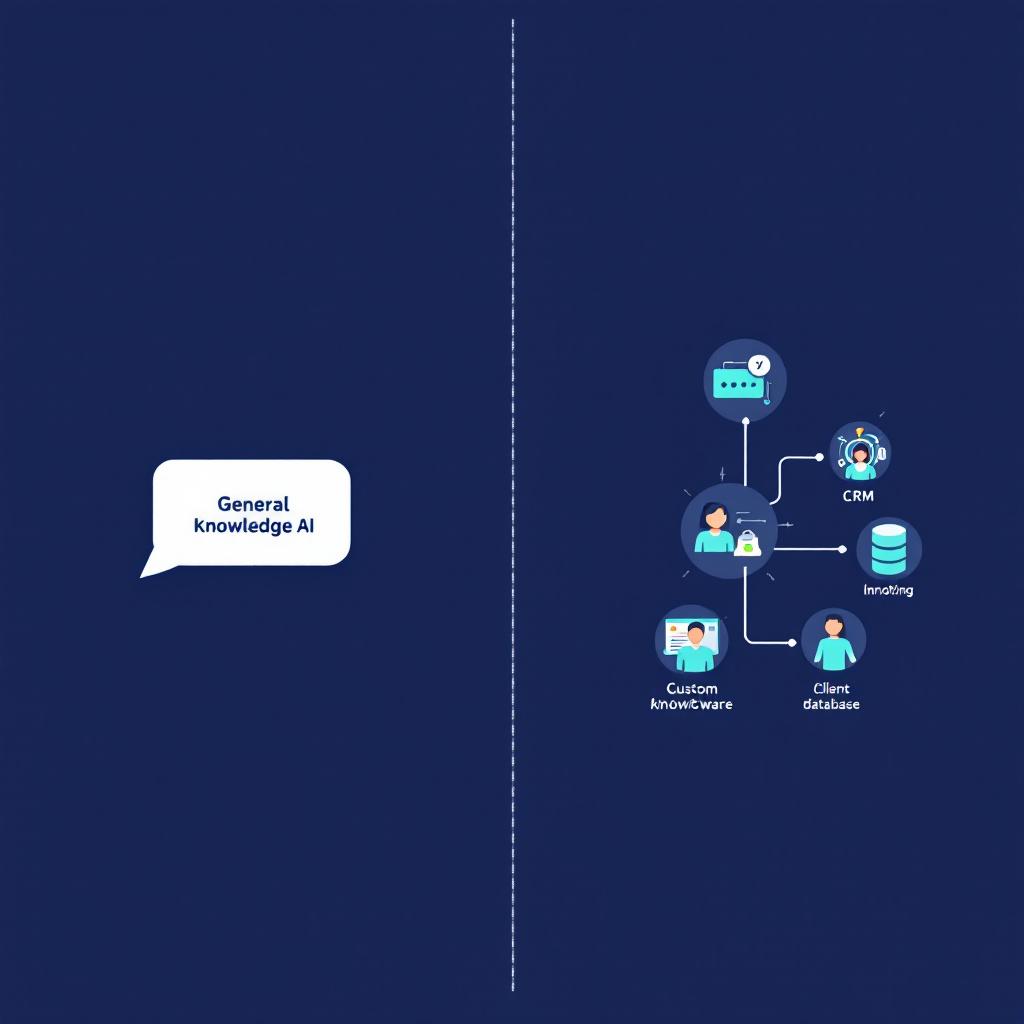
4. Your Team Has to Copy-Paste Results Into Other Systems Every Time
Here's a useful diagnostic: if your current AI workflow ends with someone copying output from a chat window and pasting it into another tool — your CRM, your EHR, your project management system — you're leaving the biggest efficiency gain on the table.
The copy-paste step is where errors enter the system. It's also the step that makes your team's time-per-task nearly the same as doing it manually once you account for prompt engineering, review, and manual transfer. A custom AI integration eliminates that step — the output writes directly to the destination system.
5. The Answers Are Generic When You Need Specific
Ask ChatGPT "how should I handle a no-show from a client?" and you'll get a reasonable answer about general business practice. Ask the same question to a custom assistant trained on your policies — with access to your client history, payment status, and appointment frequency — and you get a recommendation that actually reflects your situation.
The specificity gap matters most in high-stakes interactions: client communications that carry your brand voice, clinical documentation that needs to match your practice's exact format, sales follow-ups that reference the actual conversation history. General answers have general value. Specific answers move the business.
What "Custom AI" Actually Means (and What It Costs)
The phrase "custom AI" sounds expensive and technical, but most SMB-scale custom AI isn't building a model from scratch — it's connecting a frontier model (Claude, GPT-4, Gemini) to your business's data and tools through purpose-built integrations.
The components of a simple custom AI system:
- The model layer — a frontier LLM, accessed via API, not trained from scratch
- The integration layer — API connections to your existing tools (your CRM, scheduling software, databases)
- The prompt layer — instructions that tell the model who it is, what it can do, and how to respond for your specific business
- The interface — how your team or customers interact with it (chat widget, internal tool, Slack bot, voice)
For a focused single-purpose assistant — booking bot, session-note structurer, lead qualifier — this typically runs $8,000–$20,000 to build and $200–$600/month to run (API usage + hosting). For context on full cost ranges across project types, see our 2026 AI automation cost benchmarks.
Compare that to a ChatGPT Teams subscription at $30/user/month for a 10-person team: $3,600/year. A focused custom assistant, properly scoped, frequently returns 10–20x its build cost in the first year through time savings alone. The math depends entirely on how much time the specific automation saves, and what that time is worth.
A Real Comparison: ChatGPT Team vs a Custom Scheduling Assistant
Let's make this concrete. A pediatric therapy clinic with 8 providers handles 40+ new client inquiries per week. Their intake process: a new parent calls or emails, a staff member checks provider availability, gathers scheduling preferences, and manually books them into the system. Average time per new intake: 18 minutes.
With ChatGPT Teams ($240/month): Staff could use it to draft cleaner confirmation emails, faster. The intake process itself — the data gathering, availability check, booking — still requires a human on the phone or email, then manual entry into the scheduling system. Time saved: roughly 3 minutes per intake on drafting.
With a custom intake assistant ($12,000 build, $350/month): The assistant handles the intake conversation (via form, chat, or SMS), checks live provider availability, gathers scheduling preferences, books the appointment directly into the scheduling system, sends a confirmation with intake forms attached, and flags anything that requires human review. Time saved: 14–16 minutes per intake. At 40 intakes per week, that's 9–10 hours of staff time per week, every week.
For a clinic of this size, the custom build pays back in about 4 months. The ChatGPT subscription never does, because it's not touching the process that actually takes time. If you're curious what this looks like in practice, we built a similar system for a therapy clinic — the full implementation breakdown is here.

The Middle Path: Off-the-Shelf Tools That Connect Your Data
Building fully custom isn't always the right call. There's a growing category of off-the-shelf AI tools that ship with integrations into popular business software — and for many SMBs, these hit the sweet spot between "general chatbot" and "fully custom build."
What these tools look like in practice:
- HubSpot AI, Salesforce Einstein — if you're already deep in their ecosystem, these tools have your data and can act on it without a custom build
- Make.com + Claude/OpenAI — visual automation builder with AI steps, handles a surprising range of data-connected workflows without code
- Industry-specific vertical AI — scheduling platforms, EHR vendors, accounting software increasingly ship AI features that are pre-integrated with your data
The off-the-shelf path works best when your business runs on a mainstream stack and your automation needs align with what vendors have already built. It breaks down when your stack is unusual, your workflows are specific enough to require customization, or the vendor's built-in AI is locked behind a tier you'd rather not pay for.
How to Make the Call for Your Business
Use this framework to decide where you are on the spectrum:
Stay with a subscription if: Your primary AI use cases are drafting, summarizing, and answering general questions. Your team uses AI individually for their own productivity, not to serve customers or automate shared processes. Your workflows don't require live access to your business data.
Evaluate off-the-shelf integrated tools if: You run on a mainstream platform (HubSpot, Salesforce, major scheduling tools) that already has AI features you haven't turned on. The automation you need is standard enough that a vendor probably built it. You want connectivity without a build project.
Consider a custom build if: The process you want to automate involves your proprietary data and takes your team meaningful time every week. You're in a regulated industry with compliance requirements consumer tools don't meet. Your stack is mixed enough that no single vendor's built-in AI covers your full workflow. The ROI math works: hours saved × hourly cost × 52 weeks exceeds build cost within 12 months.
If you want to go deeper on what a custom build involves and whether it's the right next step for your business, our practical guide to building your first AI assistant walks through the architecture, tech stack, and realistic timelines — with a real case study at the end.
Frequently Asked Questions
Can I start with ChatGPT and migrate to custom AI later?
Yes, and it's often the right sequence. Use a subscription tool to identify which AI-assisted workflows actually stick with your team. The ones that become daily habits are the candidates for custom automation. Don't build something you're not sure your team will use — validate the habit first, then invest in making it faster.
Do I need to choose one or the other?
No. Most businesses that build custom AI still keep subscription tools for general productivity tasks. They're complementary. Custom AI handles the high-value, business-data-connected workflows. Subscription tools handle open-ended writing and research tasks. The question is where each dollar of investment produces the most leverage.
What if my business data is sensitive or regulated?
This is where consumer tools most clearly fall short. For HIPAA-covered health data, PCI-scoped payment data, or other regulated information, you need an AI vendor with a signed BAA or DPA, enterprise-tier data handling, and an architecture designed for your compliance requirements. A good developer will scope this from day one — it adds cost but significantly less than the alternative of a data breach or regulatory violation.
How do I know if my use case justifies the build cost?
Run the math before committing: (hours saved per week) × (hourly cost of the time) × 52 = annual value. If that number exceeds build cost in less than 12 months, the economics work. If it takes 2+ years to recoup, consider off-the-shelf alternatives first. Most custom builds we've done for SMBs pay back in 3–8 months when the process is right.
Conclusion
ChatGPT and its competitors are genuinely useful tools for small businesses. The question isn't whether to use them — it's whether they're the right tool for your highest-value use cases.
For general productivity tasks that don't require your business's data, a subscription is usually the right answer. For workflows that involve your live data, require consistent actions across your systems, or need to meet compliance standards, a custom build earns back its cost many times over by eliminating the manual steps a chatbot can't.
The dividing line isn't technical sophistication — it's whether the process requires knowing your business, or knowing the world. ChatGPT knows the world. Custom AI can know both.
If you're trying to figure out which category your use case falls into, book a 30-minute scoping conversation. Bring the specific process you're trying to automate, and we'll tell you whether a subscription, an off-the-shelf integration, or a custom build is the right fit.
About the author: Gabriel Jaramillo is the founder of Auth Software and a Board Certified Behavior Analyst. He has built custom AI systems for healthcare practices, service businesses, and SaaS companies.
Continue reading
The BCBA's Guide to HIPAA-Compliant ABA Practice Management (2026)
Most ABA agencies assume they're HIPAA compliant because they use CentralReach. They're usually wrong — not about the EHR, but about everything around it. A plain-language breakdown of what HIPAA actually requires for ABA practices, where most agencies have gaps, and how to close them.
AutomationCentralReach vs. Custom ABA Software: When Your Practice Has Outgrown Off-the-Shelf
CentralReach is the dominant EHR in the ABA market for good reason. But there's a specific set of scenarios where it stops being the right choice — and when practices hit those scenarios, they usually don't realize it until they've already built a year's worth of workarounds.
AutomationHow ABA Agencies Are Automating Billing, Intake, and Supervision Tracking with AI (2026)
The average ABA agency running 20 active clients has at least three manual workflows that consume 10–15 hours of admin time per week: authorization renewals, new client intake, and BACB supervision tracking. In 2026, all three are automatable. Most practices haven't automated any of them.